The Region Where American Road Rage Turns Deadly Most Often

When was the last time you yourself felt road rage or witnessed another driver have it?

Road rage is angry, aggressive behavior by a driver who’s upset with how someone else is driving, and it’s far from rare. According to the AAA Foundation for Traffic Safety, 96% of drivers admit to at least one aggressive driving behavior in the past year, from tailgating and rude gestures to deliberately blocking another car. Aggressive driving isn’t a fringe problem; it’s become the norm behind the wheel.

It also turns dangerous. Aggressive or careless driving is a factor in a significant share of the nation’s fatal crashes, but where that danger is worst varies dramatically from one part of the country to another.

Which US region has the worst road rage?

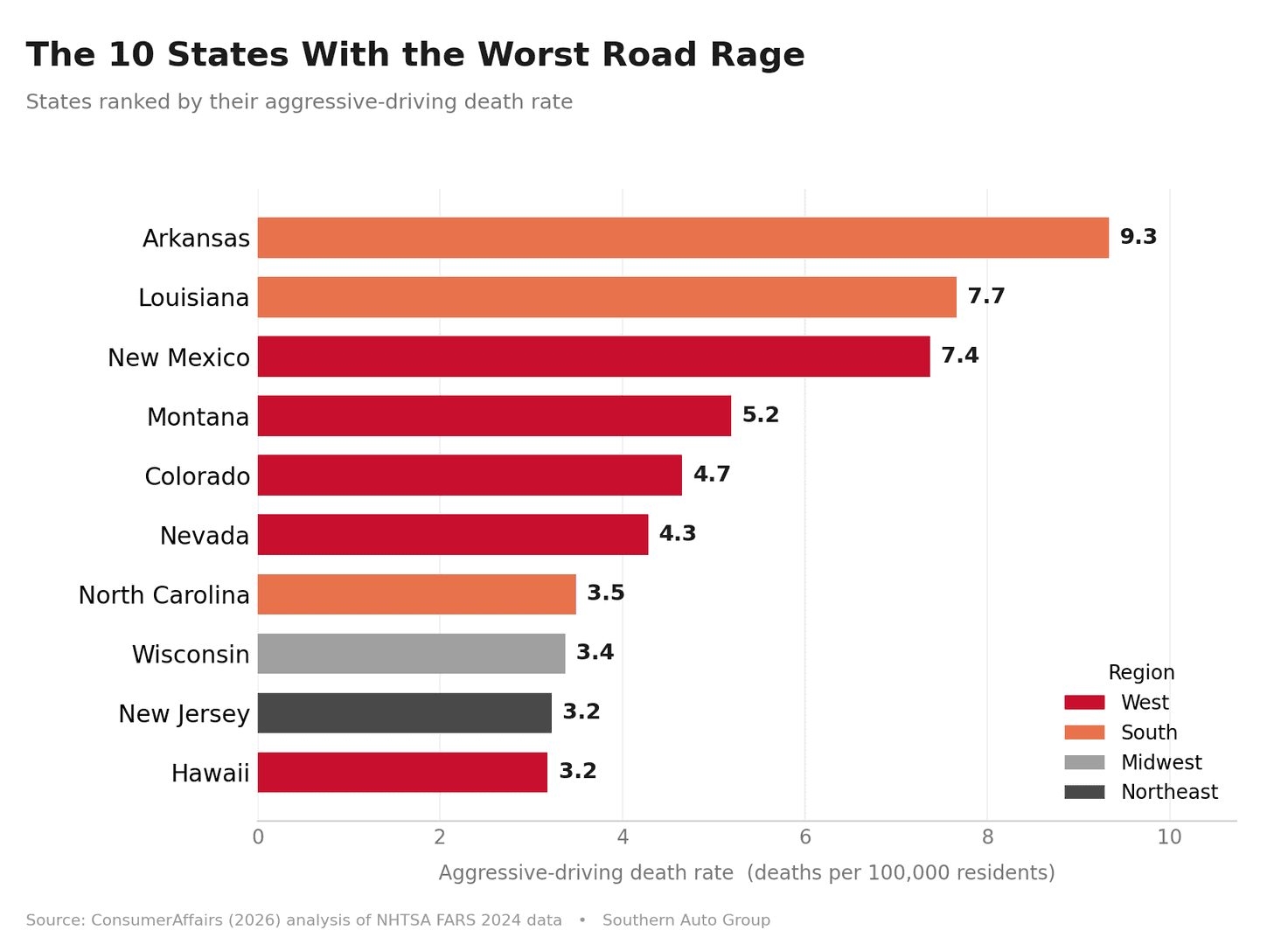
To see where road rage runs hottest, we looked at the most recent state-level analysis of ConsumerAffairs aggressive-driving crash data. The clearest pattern is regional: the West and the South dominate the worst-offending states, while the Northeast and Midwest are far less represented.
Image

As road rage is likely something most of us have experienced or witnessed, the team at Miami Lakes Automall asked psychologists with expertise in anger why we get road rage and to share their tips on how to manage it. 

Of the 10 worst states for road rage, five are in the West (New Mexico, Colorado, Nevada, Montana and Hawaii), three are in the South (Arkansas, Louisiana and North Carolina), and just one each comes from the Northeast (New Jersey) and the Midwest (Wisconsin). Arkansas ranks worst in the nation, with aggressive or careless driving involved in 48% of all its traffic fatalities–the highest share of any state–at a rate of 9.33 deaths per 100,000 residents.

By contrast, the states with the least road rage are spread evenly across the country, led by Maine, which ranks as the calmest state for the second year running. Nationally, there’s a glimmer of good news: the rates of fatal crashes and deaths involving aggressive or careless driving have each fallen by nearly 15% year over year.

“We want every driver to feel safe and confident on the road. While we often think about road safety in terms of our vehicles and how we drive, staying calm behind the wheel is just as important. No frustrating interaction with another driver is worth putting yourself or others at risk.”

Laz Veliz, General Manager at Miami Lakes Automall

Why do we get road rage?

Sarah Jeffrie, a Psychologist (MSc) and Mental Health Expert explains that “When you drive, your brain is engaged in high gear as you operate a large and potentially dangerous vehicle at high speed. Anytime you encounter another vehicle cutting you off, tail gating you or behaving erratically it will cause your brain to go into fight/flight mode prior to allowing rational thought. In addition, many drivers arrive at their vehicles carrying a great deal of additional stress stemming from issues related to their job, family, financial situation and/or lack of sleep. Therefore, it does not take much to send these individuals into a rage while operating a motorized vehicle.”

Why does being inside a car make us more confrontational?

 “Inside a car, we experience a greater sense of anonymity than if we were to have a face-to-face interaction. Most people wouldn’t yell at someone who cuts them off in line at the supermarket. However, behind the wheel, that same frustration can escalate more quickly because we feel less accountability and are more likely to assume the other driver’s actions were intentional.”

Dr. Virginia Chow, Licensed Clinical Psychologist

Top 3 tips on how to manage road rage

Miami Lakes Automall asked the experts what their tips were for managing road rage. 

About Us

Miami Lakes Automall

  1. Take slow breaths and release physical tension

Firstly, Psychologist Sarah Jeffrie says you should try “Taking a couple deep, slow breathes and loosening the physical tension within the body helps inform the nervous system that the perceived immediate danger has been removed.”

  1. Pause before assuming malicious intent 

Dr. Virginia Chow shares that “One strategy I often recommend is to pause before assuming malicious intent. Instead of thinking, “They did that on purpose,” ask yourself, “Is there another explanation?” They may not have seen you, they could be distracted, or they may even be responding to an emergency.”

  1. Remember, everyone makes mistakes

“Another strategy is to use perspective taking. Oftentimes, the anger is one-sided and directed towards the “bad” driver when most of us, at one point, have made mistakes on the road. Ask yourself, “Have I ever made mistakes driving in the past? Have I ever unintentionally cut someone off on the road? How might other drivers perceive my mistake?” Remembering our own imperfections can make it easier to extend the same grace to someone else and prevent a moment of frustration from escalating into road rage,” advises Dr. Virginia Chow.

Cite Us

APA: Socorro, K. (2026, August 25). The Region Where American Road Rage Turns Deadly Most Often. Retrieved August 28, 2026 from https://www.miamilakesautomall.com/region-road-rage-turns-deadly/

MLA: Socorro, Krystal. "The Region Where American Road Rage Turns Deadly Most Often." Miami Lakes Automall, 25 August, 2026, https://www.miamilakesautomall.com/region-road-rage-turns-deadly/

Chicago: Socorro, Krystal. "The Region Where American Road Rage Turns Deadly Most Often." Miami Lakes Automall, August 25, 2026. https://www.miamilakesautomall.com/region-road-rage-turns-deadly/

Share this article
Miami Lakes Automall 25.924029361163097, -80.29431938900011.